Quantamental Investment and Dancing with Machines: AI Drives New Trends in Asset Management
2020-12-07 18:05:41
Abstract: Quantamental investment is one of the most promising approaches for significantly enhancing investment efficiency in the current financial market. This article introduces the connotations and extensions of quantamental investment, deeply explores the technical bottlenecks currently confronted in this field and summarizes the present development in the domestic market. More specifically, the article introduces the practical path of Datayes, and also attempts to propose some assumptions regarding the potential direction of quantamental investment from a technical perspective.
Key words: Quantamental investment, investment technology, few-shot learning
Category: (refer to Category approaches of the National Library of China)
Document code: A
Article ID: 2096-5036(YYYY)NN-PPPP-CC (added by the Editing department of Journal)
Main Body
Data shows that by 2030, the scale of the asset management market in China is expected to reach RMB 254 trillion. Asset management will become the main battle ground in the financial industry in the next decade. Under the broader context of the gradual upgrading of empowerment through technology, there has been a significant acceleration in the transformation of investment research. Quantitative fundamental investment has gradually become the industry standard. Finding ways to more effectively combine investment and technology and obtain the optimal returns has become one of the industry’s most important questions, which is worth continuous exploration.
In traditional fundamental investment, researchers and fund managers usually follow this process: extensive reading of a large amount of announcements and reports, conducting company research, and face-to-face communications with the prospect’s secretary of the board of directors, and then analyzing the fundamentals and valuation based on economic and financial theories; finally, they will conclude an investment strategy and start their investment in the prospects.
However, unprovable “hidden logic” remains present everywhere. To address this challenge, people have resorted to a new investment approach which leverages the advantages of AI technology in processing massive amounts of data and utilizes statistical principles and probability models to search for effective factors that can be integrated for investment guidance. This new investment approach is called quantitative investment.
It is clear that quantitative investment and fundamental subjective investment follow two different approaches. Quantitative investment relies more on data, pays greater attention to backtest results and the current performance of investment products, and selects investments in a more scattered way; fundamental subjective investment relies more on investment logic, focuses more on the interpretability of these logics and the long-term value of products, and selects investments in a relatively concentrated way.
The combination of the two different approaches is what we call quantamental investment. In essence, quantamental investment is based on the logic of fundamental subjective investment, and uses AI technology to portray every detailed parameter in the logic chain to ensure logical interpretability while also attaining convincing results from the perspective of backtesting. From an implementation perspective, quantamental investment incorporates fundamental factors into the AI model to form an investment system in which human and machine interact in ways that provide mutual assistance. From a modeling perspective, traditional quantitative models are based on statistics and focus on the compatibility of assumptions, while AI models focus on having data speak and simulate human behavior [1].
The combination of quantitative investment and fundamental investment greatly expands the alpha depth that traditional quantitative methods can capture in theory; it also improves the accuracy of subjective judgments in fundamental methods, and significantly increases the corresponding coverage.
Quantamental Investment translated by Professor ZHANG Ran of Peking University has extensively explained the theory of Quantamental Investment. To summarize, the essence of Quantamental Investment is to quantify the future value of the prospects. The book, like a beacon, points out the direction for Quantamental Investment.
The fact is, the financial market is in essence a projection of economic life, with various analytical frameworks and core logics in different fields. In addition, AI is far from omnipotent in terms of deep understanding at the current stage. Therefore, a more practical path is to portray independent models based on different logic in various fields. This requires practitioners to have a deep understanding of the subjective investment logic of fundamentals on the one hand, and identify appropriate AI technologies that fit the logic of the corresponding field on the other hand.
3 Technological breakthroughs in Quantamental Investment
At present, there are three challenges to be addressed before Quantamental Investment technique can be applied. First, compared with international markets, retail transactions account for as much as 80% of China’s A-share market, leading to more frequent emotional fluctuations in market prices. This translates into technical language as a relatively high proportion of noise in price signals. Second, monthly and quarterly data are the mainstream frequencies in fundamental data observation. The duration of the Chinese market is shorter than that of the US market, which leads to a limited span of historical data. Lastly, what is more challenging is that quantamental investment needs to develop different models for each of the prospects to better reflect the different logics. Therefore, many techniques in the AI field fail to deliver expected results due to aforementioned challenges.
Another interesting observation is that, despite the fact that investment in technologies is continuously making headlines, very few papers are published about quantamental investment at the top AI summits ICML, ICLR and NIPS. Even at the top summits, AAAI and IJCAI, which are more biased towards application, there have been few papers within this area. Although there is a tendency against publication of this kind of technological development, the extreme contrast presents a demonstration of the challenges facing technological development in the field of financial investment. Finally, it’s worth nothing that within the financial academic circle, a number of projects are being conducted on asset pricing [2,3], but most of them are based on the assumptions of classic pricing theory, which have not reached the depth of real investment logic, and the stability of these research results have yet to be practically tested.
To sum up, when going back to the essence, two technical challenges lie at the core of the quantamental investment. The first is the low signal-to-noise ratio and the second is few-shot learning. Scenarios for few-shot learning are different from those for meta learning, which assumes that there are a series of highly similar tasks. Although the number of samples for each task is limited, the total number of samples could reach some magnitude. While in scenarios of quantamental investment, it’s quite hard to assemble such a large number of highly similar tasks. For example, even for stocks within the same industry, it’s still necessary to construct an independent company model for each stock.
While some problems still remain to be resolved in the academia, significant progress has been achieved within the market that showed promising applications. This article will discuss the progress achieved by asset managers, security firms and FinTech firms.
Public funds have developed rapidly in recent years, and many of these funds are utilizing quantamental investment. Statistics show that there are currently 1,495 actively managed stock-oriented funds, among which, 595 funds have incorporated the concept of ” Quantamental Investment ” in their strategy with a total AUM of RMB714 billion, accounting for 32.29% of total active stock-oriented funds.
How does quantamental investment contribute to the portfolio performance? The average Sharpe ratio of the past 1 year demonstrated that there is no material difference between quantamental investment vs non-quantamental investment. Specifically, we selected two typical quantitative funds for further exploration. Compared with the collective Sharpe ratio of 1.79 of quantamental investment enabled stock-oriented funds, the differences between Fund A (superior to the benchmark) and Fund B (inferior to benchmark) demonstrated that there is an inconsistency in successful application of the concept. According to public information, the two funds only applied quantamental investment approaches in the selection of stock allocation at macro and industrial level, and didn’t develop specific models for stock selection.
It can be observed that quantamental investment capabilities still need to be further improved whether in terms of return performance of real public funds or scalable forecast and analysis.
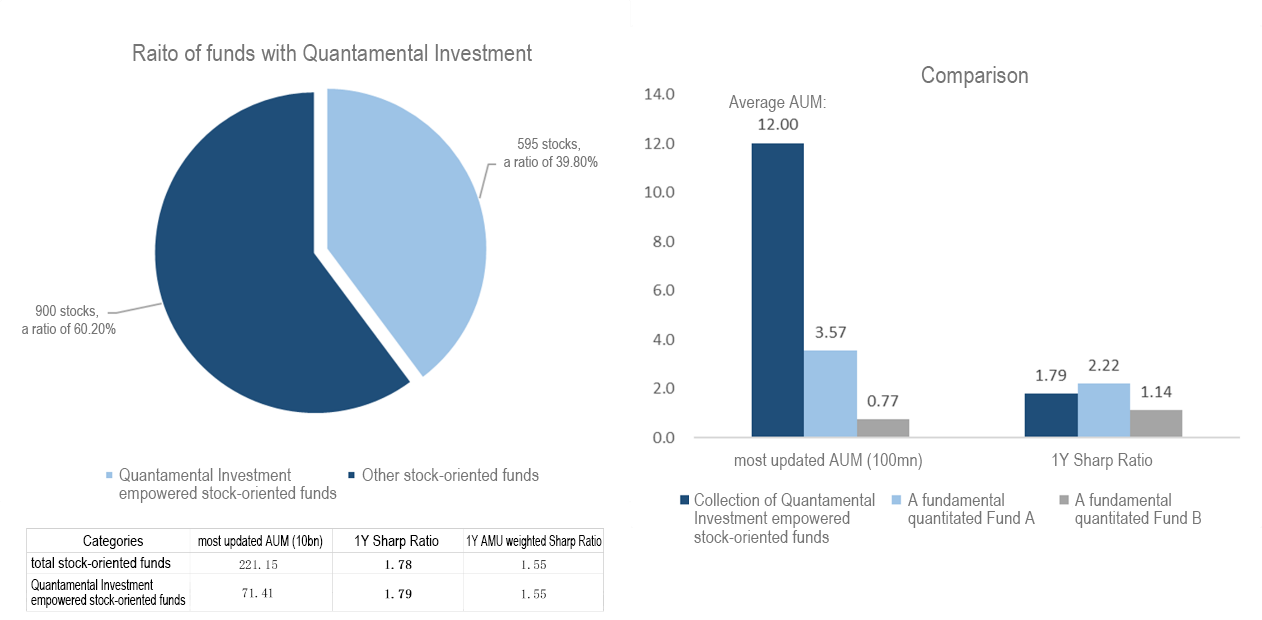
(Data from Datayes!, Statistics as of 2020-10-19)
4.2 Financial engineering within security firms
There are three categories of work that are closely related to Quantamental Investment [4-11]. The first one is industry prosperity forecast [5,6,7], which focuses on identifying the leading factors that are recognized by analysts as driving forces for industry prosperity, and then establishing a mapping relationship between these leading factors with industry prosperity in a way that removes collinearity to finally achieve forecast capability. This forecast is highly practical for business purposes, but it does not directly touch upon the price level, which is what drives investment strategy. The second is the prosperity conduction analysis of the industrial chain [8], which focuses on analyzing the relationship between the price and output of the corresponding upstream and downstream products within the same industrial chain, and then quantitatively obtaining the degree of influence of upstream prosperity on the downstream, and then making investment strategies accordingly. The third is the valuation analysis of individual stocks [10], which focuses on fitting the long-term trend and range between fundamentals and valuations, thereby judging the reasonable valuation multiples of a stock to derive the corresponding investment strategy.
Of these tasks, the latter two focus directly on investment strategies, and have two shortcomings: first, the application is not used deeply enough within fundamental level, and they have not dug into further factors that affect fundamentals; second, the technological application stays mainly within shallow models, and can therefore not easily capture the nonlinear relationship between high-dimensional data. In addition, there are massive research efforts [4,9,12] going on, which we will not go into details about due to length limitations of this article.
Reforms in investment research are accelerating, and FinTech firms are playing their roles. For example, Datayes is a FinTech firm that focuses on studying the relationship between high frequency data and fundamentals. Taking individual stock forecasts as an example, investment researchers generally focus on the annual profitability of listed companies, and then make forecast about investments. At present, there are some mature Analyst Consensus Forecasts in the market. However, due to the low frequency of the Analyst Consensus Forecast and limited coverage, the timely update of machine based Consensus Forecasting could be a powerful supplement to the current consensus forecast market. Datayes provides independent company models, which we call investment research framework. Utilizing the mainstream investment research logic in the market, Datayes links high-frequency data that can reflect the revenue and cost of listed companies to the corresponding investment research framework, and then installs an AI forecast-based machine engine for these framework, which then can produce real time forecasting of companies’ revenues and profitability, and deduce any one of the forecast values in the three data sheets: the balance sheet, income sheet, and cash flow sheet, leveraging on the financial collusion relationships of these financial data.
We believe that the most effective solution is financial empowerment with humans playing a central role while fully exploring the virtues of technology. Based on the above logic, we will further explain two advantages of quantamental investment.
First, from an application perspective, in the long run, as long as the machine’s forecast, compared with Analyst Consensus Forecast, are sufficiently close to the true future value, and when the valuation does not deviate significantly, the stock price will fluctuate around a reasonable range eventually, allowing machine forecasts to be directly applied to the valuation. More importantly, whenever the underlying high-frequency operating data changes, theoretically, the machine’s forecast will also change. The empirical findings showed that stocks perform negatively within a week after they are machine forecasted with material decline. This statistically high correlation provides a realistic approach for short-term risk alarming.
Second, achieve Nowcast by leveraging the time difference between availability of high-frequency data and that of financial report. When we talk about forecasting, the first question we should ask is why the revenue and profit of individual stocks can be forecasted? For instance, in the forecast of the most recent quarterly report, if the forecast happens when a report has been completed but not disclosed, the existence of this time difference is a Nowcast problem.
Vague correctness is more valuable than precise error. Take Q3 in 2020 for example. Generally speaking, business operations have happened in Q3, but the Q3 report is usually not disclosed until late October, while the high-frequency data as of September has already been generated, so forecasts based on this data is highly reliable. In essence, this is not a forecast, but a deep dive into the relationship between high-frequency data that has occurred and the quarterly report.
From quarterly forecasts to 3-year forecasts, frankly speaking, forecast accuracy is indeed more challenging for targets that have not been completed during the forecast period. But the default assumption of the underlying logic is that the macro and industry landscape will not frequently undergo drastic changes. Under this premise, based on single stock analysis logic, machines can follow different logic by business, and fully explore the leading and lagging characteristics of different data, use periodicity more accurately, and adjust systemic biases based on feedback, so as to obtain a statistically more optimized result.
Datayes’ multiple experiments provided some references for how machine computing power could be utilized to expand human cognition and make more precise forecasts. In the 2019 annual report forecast experiment, Datayes! forecast beat the market consensus with a winning rate of 82.5%. The average error between the AI model forecast result and the annual report actual value is 2.04%, which is lower than the sell-side Analyst Consensus error value of 3.80%.
In addition, in the subsequent forecast activities of 2020 mid-year report, even with the great impact of the black swan event of the coronavirus pandemic, the median error of the AI forecast results was locked at 2.07%. At the same time, in the revenue forecasts of listed companies such as Boss Electric, Wuliangye, Shanxi Fenjiu, Hengshun Vinegar, Yifeng Pharmacy, Yunnan Baiyao, Dalian Port, and Shanghai Jahwa, AI’s forecast error is within 1%, a considerable accurate rate. (Note: there is no market consensus on the half-year financial report and quarterly report, so the forecast error statistics is only for reference.)
How can we optimize the stability and reliability of AI forecast in real investment?
First, leverage the unique advantages of alternative data. With the wide application of traditional data (e.g., financial data) in constructing investment models, “factor trading” is becoming increasingly crowded, and information asymmetry is disappearing. Expectations for alternative or non-traditional data have been growing. For example, Datayes exclusively acquired the data of offline supermarkets and online e-commerce. Updated on a monthly basis, these data are disclosed in advance of official financial reports, and provide information on goods sales, volume, and average prices and the share of different brands of listed companies in the consumer industry to more closely track the operations of companies. Loading these alternative data into an AI forecast model will improve the reliability of forecast outcomes.
Second, look for forecast engines suitable for small data. As mentioned above, quantamental investment presents two major technological challenges. Since share price is not included in the scenario, few-shot learning will be our first concern. According to learning theory, we need to control the bias and variance of forecast outcomes. Usually, a complex model leads to low bias and high variance; while a simple model leads to high bias and low variance. Therefore, from the perspective of problem solving, a model with low complexity will be the first choice. On the other hand, when data is scarce, priori knowledge will be effective support for model election. More specifically, we can select suitable small models or kernels for different types of raw data, which will help produce a middle level forecast outcome through each small model for the original problem. The last step is to integrate all these small models and produce a perfect outcome with small bias and low variance. We can involve algorithm experts throughout the entire process to make fully customized models; or introduce some pre-processing and post-processing links to conduct semi-automatic factor selection and model selection, so as to quickly build a large number of semi-custom models in batches. With this whole set of processes, the Datayes model solves the problem of few-shot learning in quantamental investment.
It is worth mentioning that the few-shot learning algorithm in meta learning is not suitable for scenarios of quantamental investment. A broader phenomenon is that even the simplest neural network may overfit the fundamentals. Another possible reason for inapplicability is that the current meta learning framework is not suitable for applying the human priors to different fundamental data, leading to the loss of important information that restricts the complexity of the model. One promising direction is finding ways to improve the meta learning framework to help make better use of sharable knowledge of different stocks.
Quantamental investment is like an early sun in the morning, just dawning on the horizon. Currently, all major institutions are making their own attempts, while few technical routes are recognized by all parties from a methodological point of view. We think the following directions are promising for potential future explorations:
First, how do we generate a good strategy? Take Datayes for example. Our current fundamental analysis is quite adequate, but cannot correspond well to the stock price. We still need to solve the low signal-to-noise ratio of financial data to achieve a better correspondence. At the same time, how can we meet the high requirements of sequential decision theory for abundant data in order to produce high-quality strategies? In practice, although we can give up the requirement that automatic learning should include strategy generation, the problem still theoretically exists and is of great significance.
Second, how should we integrate the independent models? The mainstream of quantamental investment is to establish a company model for each stock. For this, finding ways to balance the risk budget between different stocks and achieve a theoretical optimum is of high significance, and this is also a blank to be filled in financial theory. It is worth mentioning that the solution of the classic risk model (Risk Model) does not fully utilize the features and the characteristics of these independent company models, and is therefore difficult to use as a theoretical optimum.
Third, where is the boundary of the quantamental investment? Even if we can solve the above problems, due to the fact that many investment decisions are related to counterparties, finding ways to collect and identify public information of the counterparty and to utilize the gaming mechanism in multiple player games in order to achieve a better pricing is a far-reaching issue.
The financial market is an endless testing ground, and the pursuit of greater strength is endless as well. This is the future direction for smart investment by integrating classic knowledge and frontier technology and better exerting the wisdom of human beings and machines. We believe that every step forward will make the market more effective. Let’s embrace the new world of quantamental investment with greater energy and patience.
References
[1] Juhi Ramzai, “Clearly Explained: How Machine Learning differs from Statistical modeling”( 2020). Available at https://towardsdatascience.com. (博客)
[2] Chen, Luyang and Pelger, Markus and Zhu, Jason, “Deep Learning in Asset Pricing” (September 10, 2020). Available at SSRN: https://ssrn.com/abstract=3350138. (期刊)
[3] Shihao Gu, Bryan Kelly, Dacheng Xiu, “Empirical Asset Pricing via Machine Learning“( 2020). The Review of Financial Studies, vol 33(5), pages 2223-2273. (期刊)
[4] 丁鲁明,中信建投的《基本面量化思考》、《基本面量化》系列(研报)。
[5] 吴先兴,天风证券的《行业景气度量化前瞻》系列(研报)。
[6] 刘富兵,国盛证券的《量化专题报告——行业基本面量化》系列(研报)。
[7] 杨国平,申万宏源的《宏观、供需及上市公司维度行业景气度研究》、《申万主动量化行业景气研究》系列(研报)。
[8] 刘宾,中信期货的《商品量化基本面因子探索之×》系列(研报)。
[9] 陈杰,华创证券的《×行业基本面量化研究》系列(研报)。
[10] 王红兵,银河证券的《主动量化:个股绝对收益之×》系列(研报)。
[11] 吴先兴,天风证券的《金融工程:改善一致预期》系列(研报)。
About Author:
LUO Ge graduated from Hong Kong University of Science and Technology with a Ph.D. in Computer Science and earned a bachelor’s degree from the YAO Qizhi Class of Tsinghua. He has rich experience in AI implementation, and has conducted extensive empirical and effective exploration in the combination of AI and quantamental investment. He led algorithm construction and development of frameworks of individual stock profit forecasting, industry prosperity forecasting, and macro analysis in Datayes!. He has conducted in-depth research and experienced in the field of few-shot learning.